Pagoda Travel
A B2B travel marketplace connecting agencies with local guides
A B2B travel marketplace connecting agencies with local guides
Project Details
Project Details
Services
Web App
Web App
Web Design
Web Design
Creative Strategy
Creative Strategy
Client
Pagoda Travel
Pagoda Travel
Location
Japan
Japan
Duration
5 months • 2025
5 months • 2025
Team involved
1 Lead Product Designer
4 Product Designers
3 Software Developers
1 Client Stakeholder
1 Lead Product Designer
4 Product Designers
3 Software Developers
1 Client Stakeholder
Info
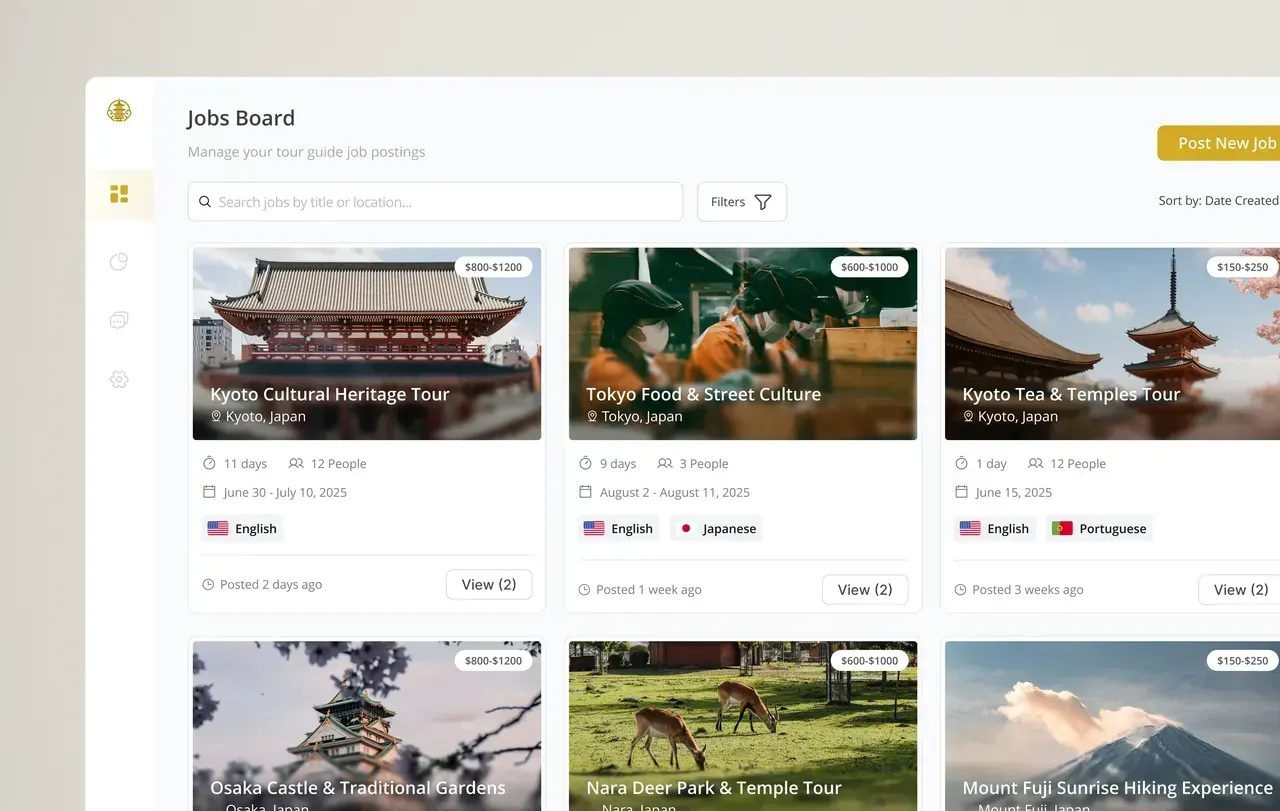
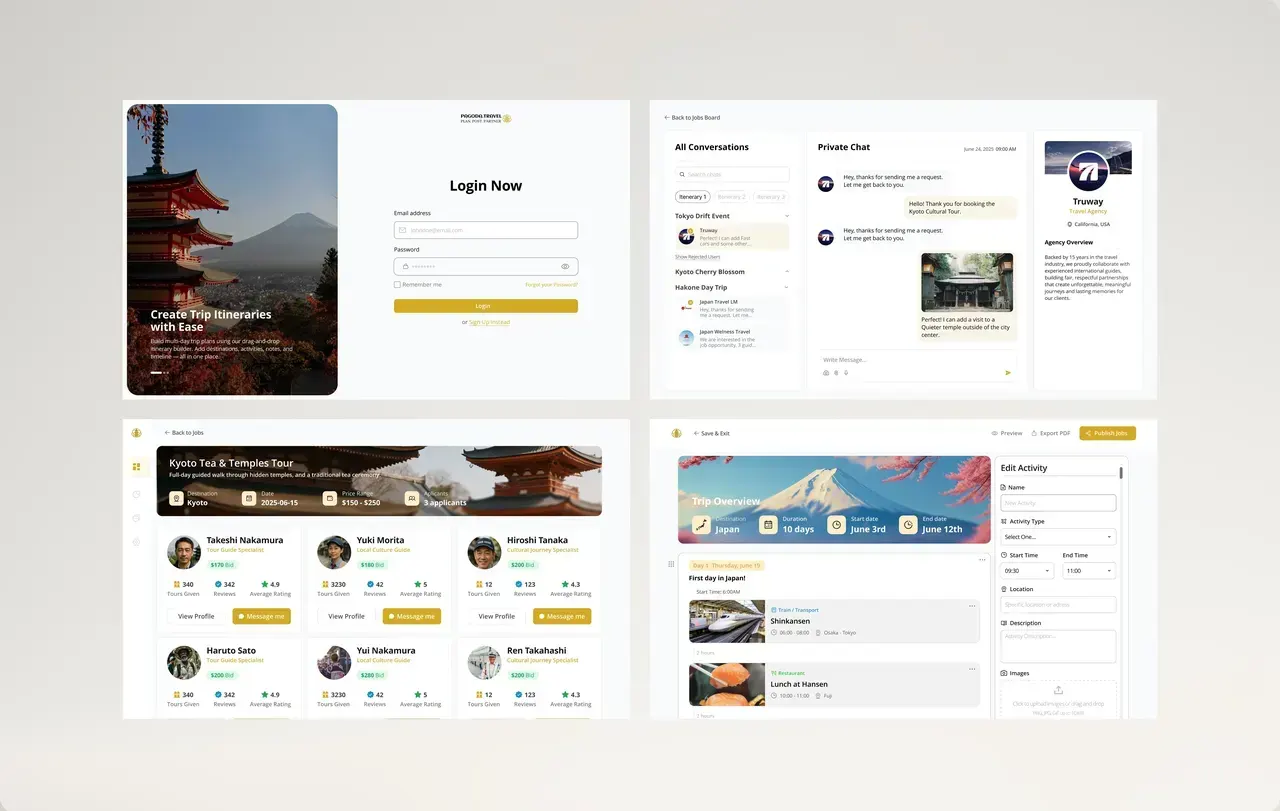
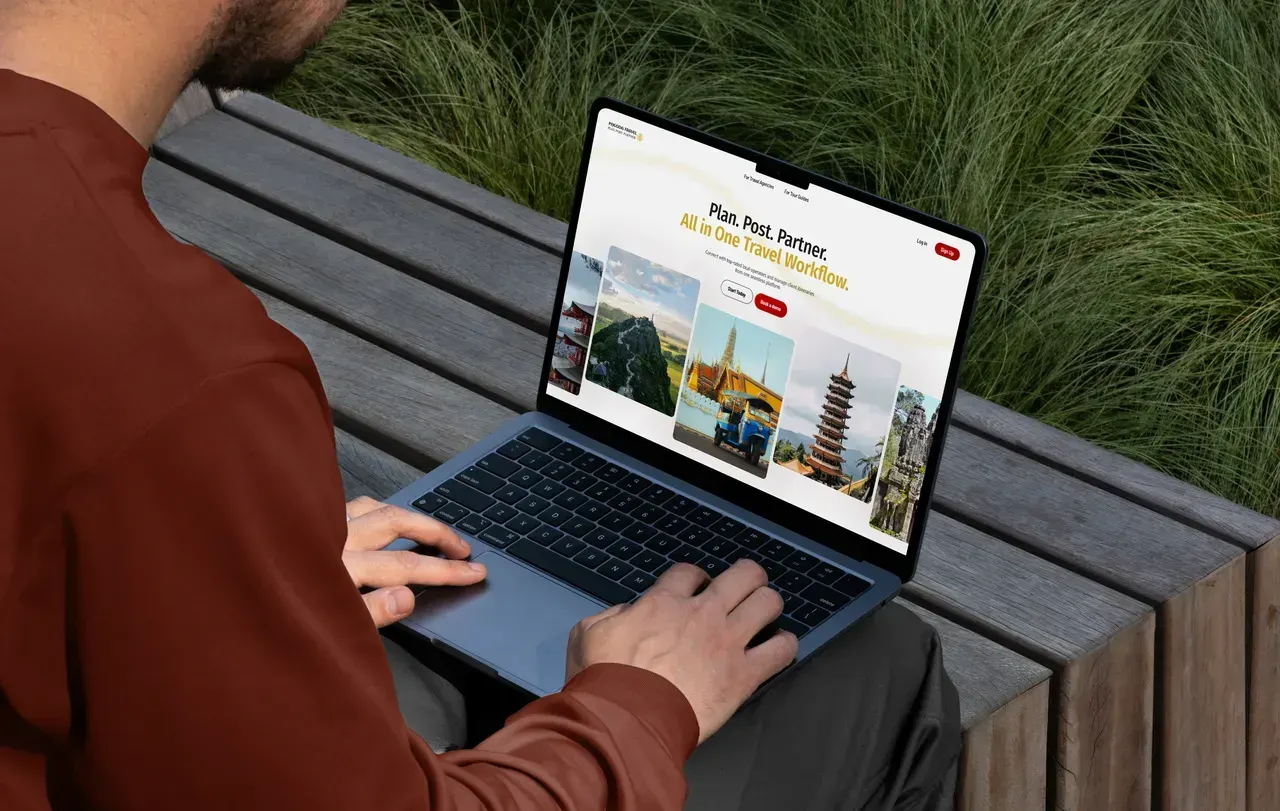
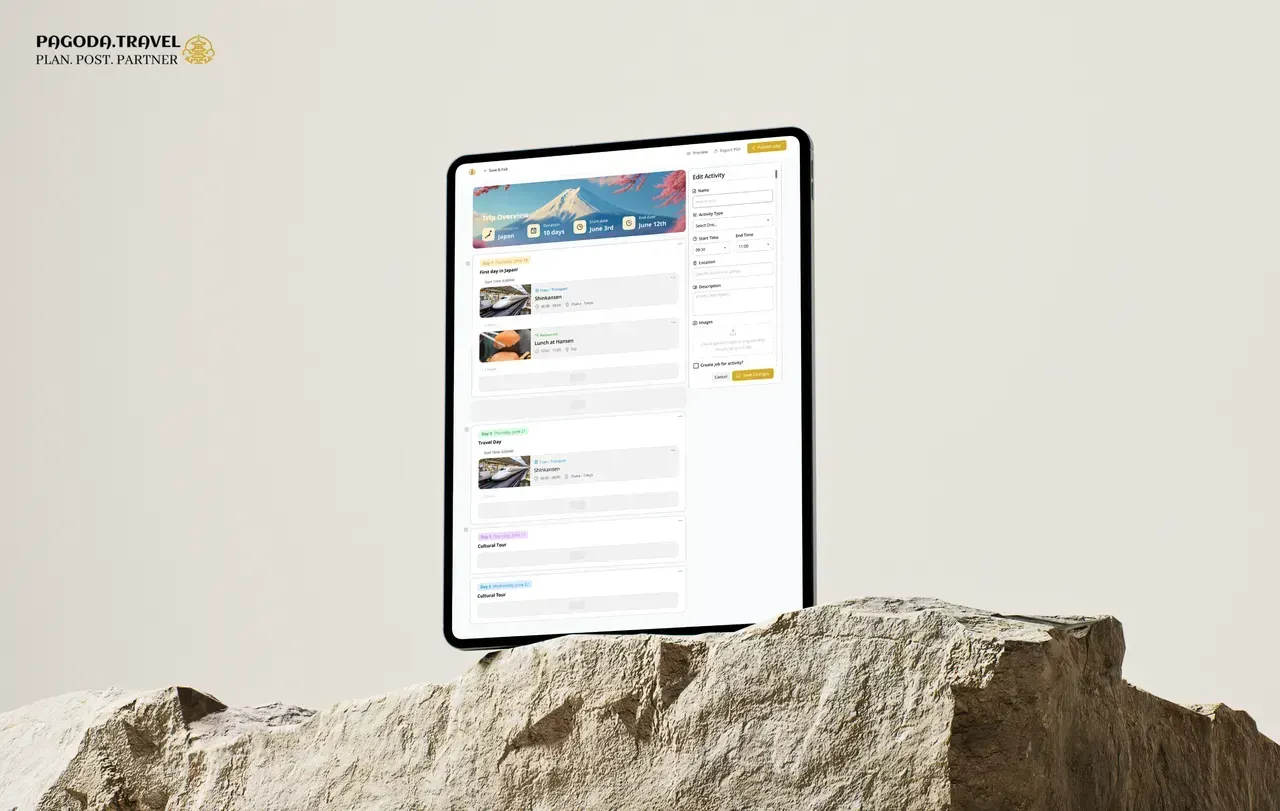
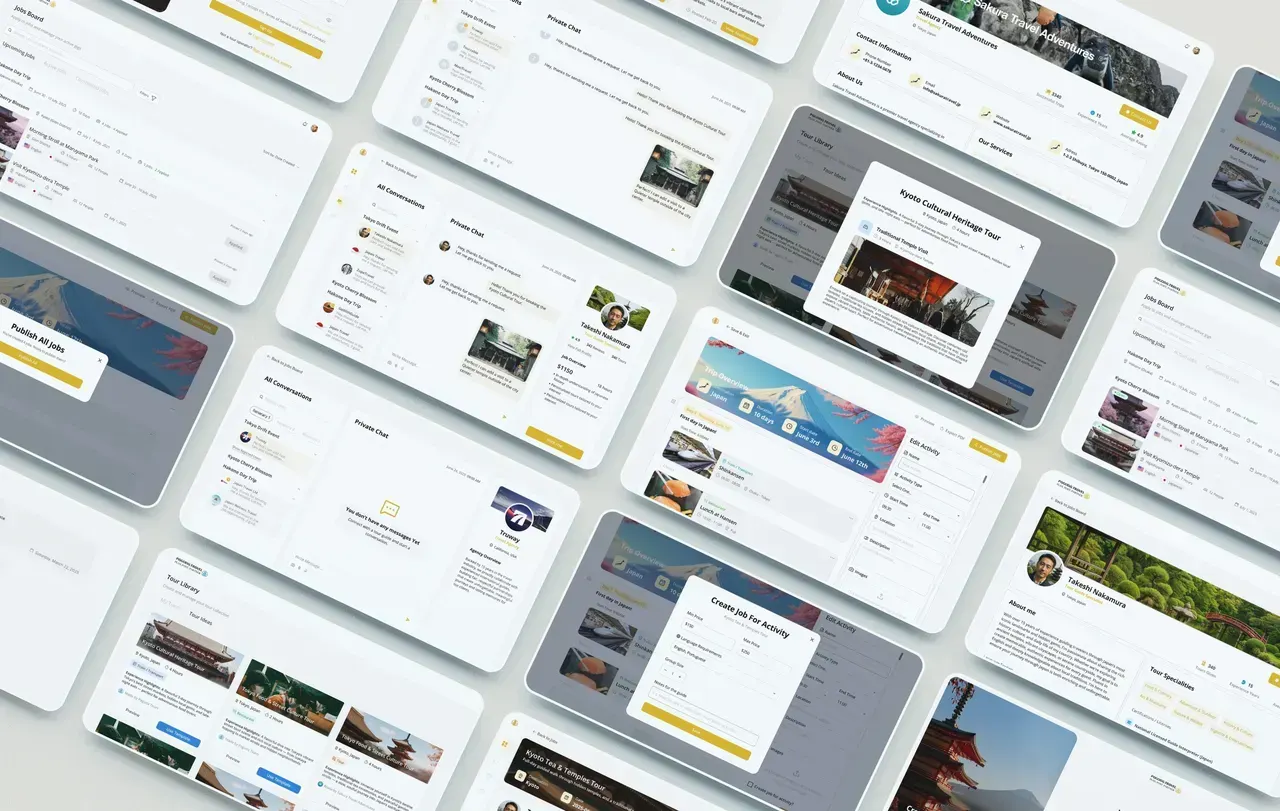
Pagoda Travel needed more than a marketing site, it needed the actual infrastructure for a two-sided marketplace connecting travel agencies with local tour guides. Agencies build detailed, day-by-day itineraries for their clients, then need a way to hire vetted local guides for each leg of the trip without endless email threads and spreadsheets. We designed and built the web app itself: a drag and drop itinerary builder, a job board with bidding, guide profiles, and in-app messaging, all connected so a trip built in the morning can have a guide bidding on it by the afternoon.
Pagoda Travel needed more than a marketing site, it needed the actual infrastructure for a two-sided marketplace connecting travel agencies with local tour guides. Agencies build detailed, day-by-day itineraries for their clients, then need a way to hire vetted local guides for each leg of the trip without endless email threads and spreadsheets. We designed and built the web app itself: a drag and drop itinerary builder, a job board with bidding, guide profiles, and in-app messaging, all connected so a trip built in the morning can have a guide bidding on it by the afternoon.
Impact & Context
Impact & Context
The Impact
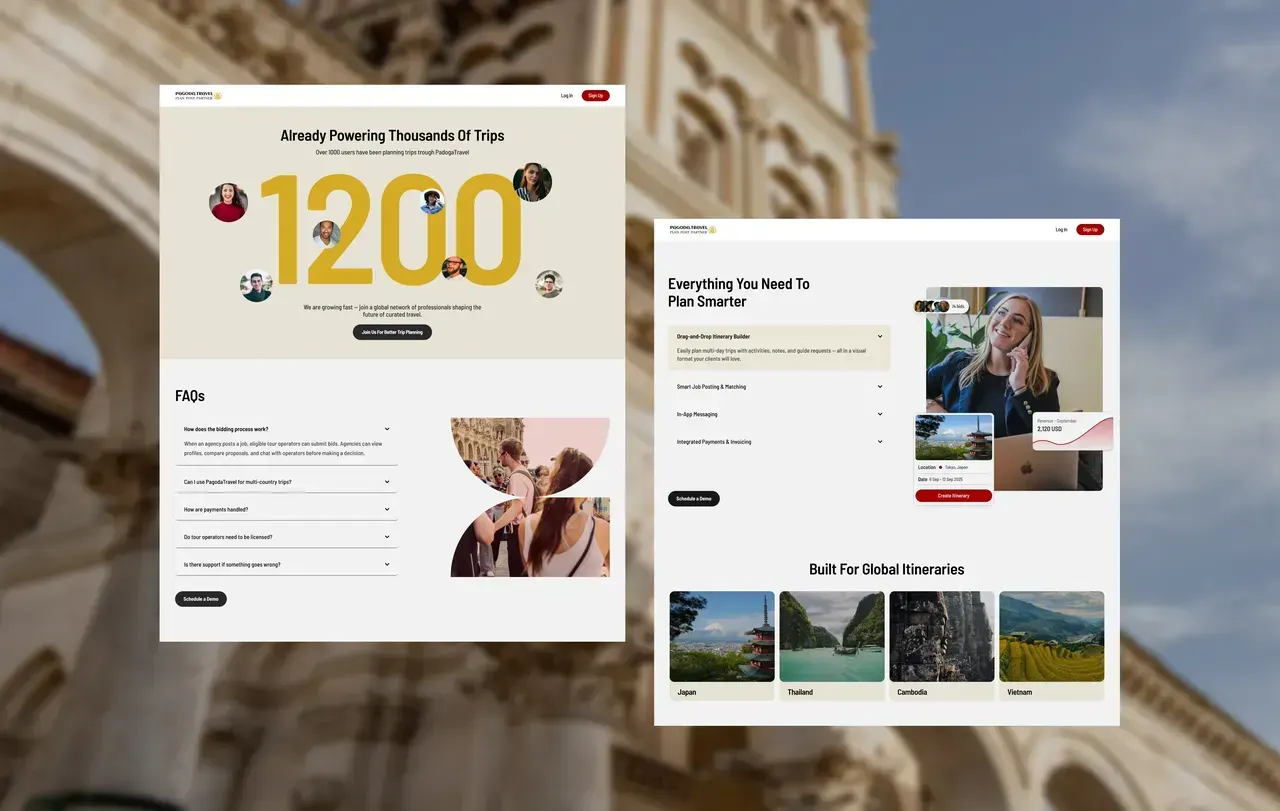
Pagoda Travel needed more than a marketing site, it needed the actual infrastructure for a two-sided B2B marketplace connecting travel advisors with vetted local guides, operators and destination-management companies across Japan. I designed the public website and the operational web app as one connected system, centralising itinerary building, supplier discovery, bidding, collaboration, booking and payment into a single workspace that previously ran across email threads, spreadsheets and separate supplier tools.
Pagoda Travel needed more than a marketing site, it needed the actual infrastructure for a two-sided B2B marketplace connecting travel advisors with vetted local guides, operators and destination-management companies across Japan. I designed the public website and the operational web app as one connected system, centralising itinerary building, supplier discovery, bidding, collaboration, booking and payment into a single workspace that previously ran across email threads, spreadsheets and separate supplier tools.
Highlights
Two connected layers, one experience: Designed the public website (proposition, programmes, pricing, trust model, registration and demo pathways) and the web app (account creation, itinerary building, job posting, supplier comparison, booking, payment) as a single, coherent system rather than two separate builds.
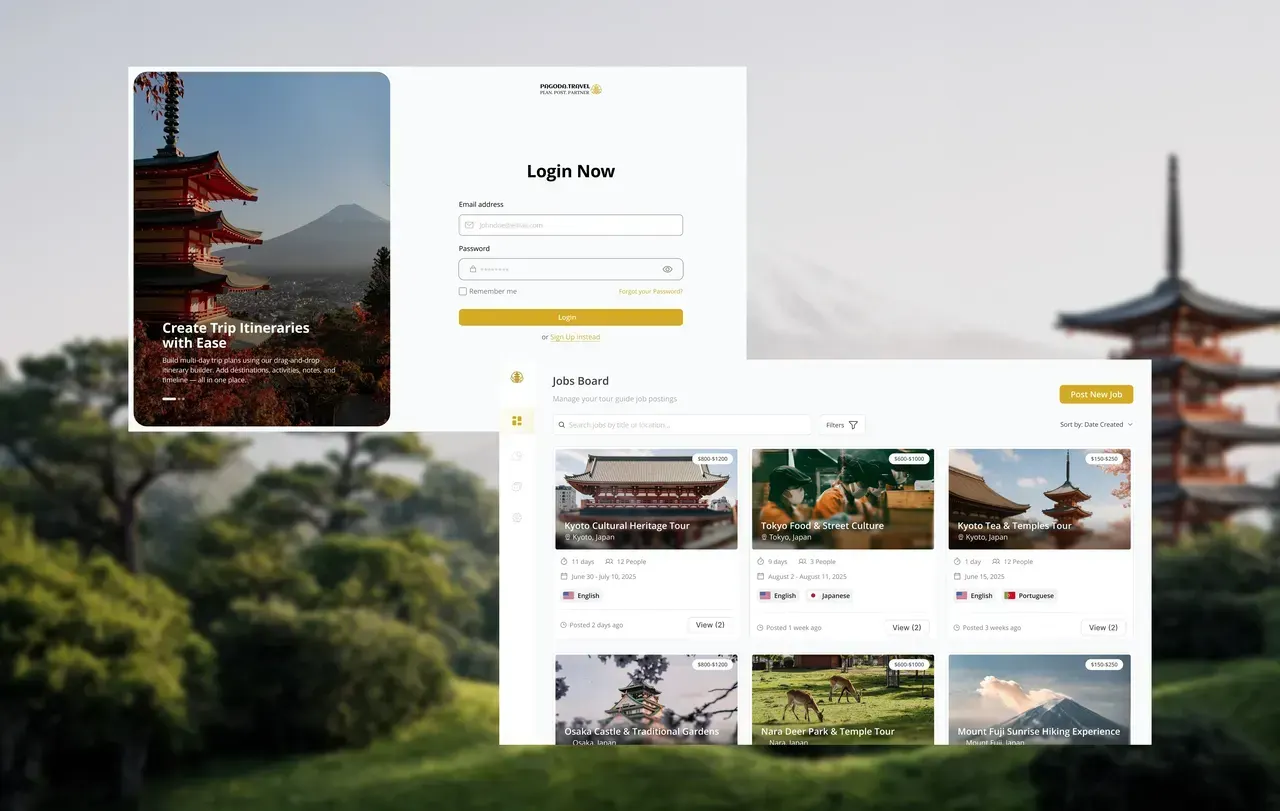
Itinerary as the entry point to the marketplace: Treated itinerary creation as the front door to hiring, not a separate tool, so a day built in the planning flow could become a biddable job without leaving it.
Real-time collaboration at the core: Built in-app messaging on Supabase and a live escalation path, a panic button visible to both parties that alerts admin, directly into advisor-guide conversations.
White-labelled trust protection: Designed proposal flows that let advisors present Pagoda's supplier network to their own clients under their own brand, protecting the advisor-client relationship the marketplace depends on.
Two connected layers, one experience: Designed the public website (proposition, programmes, pricing, trust model, registration and demo pathways) and the web app (account creation, itinerary building, job posting, supplier comparison, booking, payment) as a single, coherent system rather than two separate builds.
Itinerary as the entry point to the marketplace: Treated itinerary creation as the front door to hiring, not a separate tool, so a day built in the planning flow could become a biddable job without leaving it.
Real-time collaboration at the core: Built in-app messaging on Supabase and a live escalation path, a panic button visible to both parties that alerts admin, directly into advisor-guide conversations.
White-labelled trust protection: Designed proposal flows that let advisors present Pagoda's supplier network to their own clients under their own brand, protecting the advisor-client relationship the marketplace depends on.
Organizational Context
Product strategy: Centred on turning a fragmented, email-and-spreadsheet-driven booking process across multiple suppliers into a single, trustworthy digital marketplace for Japan-based travel planning.
Discovery & UX research: Grounded in mapping the real workflow travel advisors and local guides already used, itinerary planning, supplier outreach, bidding and payment, to understand where a shared digital workspace could replace fragmented, off-platform coordination.
Metrics: The product was not formally tested after delivery, so no first-party results exist. Publicly, Pagoda states it launched Japan operations in 2023, provides access to 100+ vetted suppliers, and aims to save advisors up to 75% of proposal-building time, these are the company's own stated claims, not measured outcomes of this design work.
Processes: 1 Lead Product Designer, 4 Product Designers, 3 Software Developers and 1 Client Stakeholder, over a 5-month engagement in 2025.
Product strategy: Centred on turning a fragmented, email-and-spreadsheet-driven booking process across multiple suppliers into a single, trustworthy digital marketplace for Japan-based travel planning.
Discovery & UX research: Grounded in mapping the real workflow travel advisors and local guides already used, itinerary planning, supplier outreach, bidding and payment, to understand where a shared digital workspace could replace fragmented, off-platform coordination.
Metrics: The product was not formally tested after delivery, so no first-party results exist. Publicly, Pagoda states it launched Japan operations in 2023, provides access to 100+ vetted suppliers, and aims to save advisors up to 75% of proposal-building time, these are the company's own stated claims, not measured outcomes of this design work.
Processes: 1 Lead Product Designer, 4 Product Designers, 3 Software Developers and 1 Client Stakeholder, over a 5-month engagement in 2025.
Design Challenge
Design Challenge
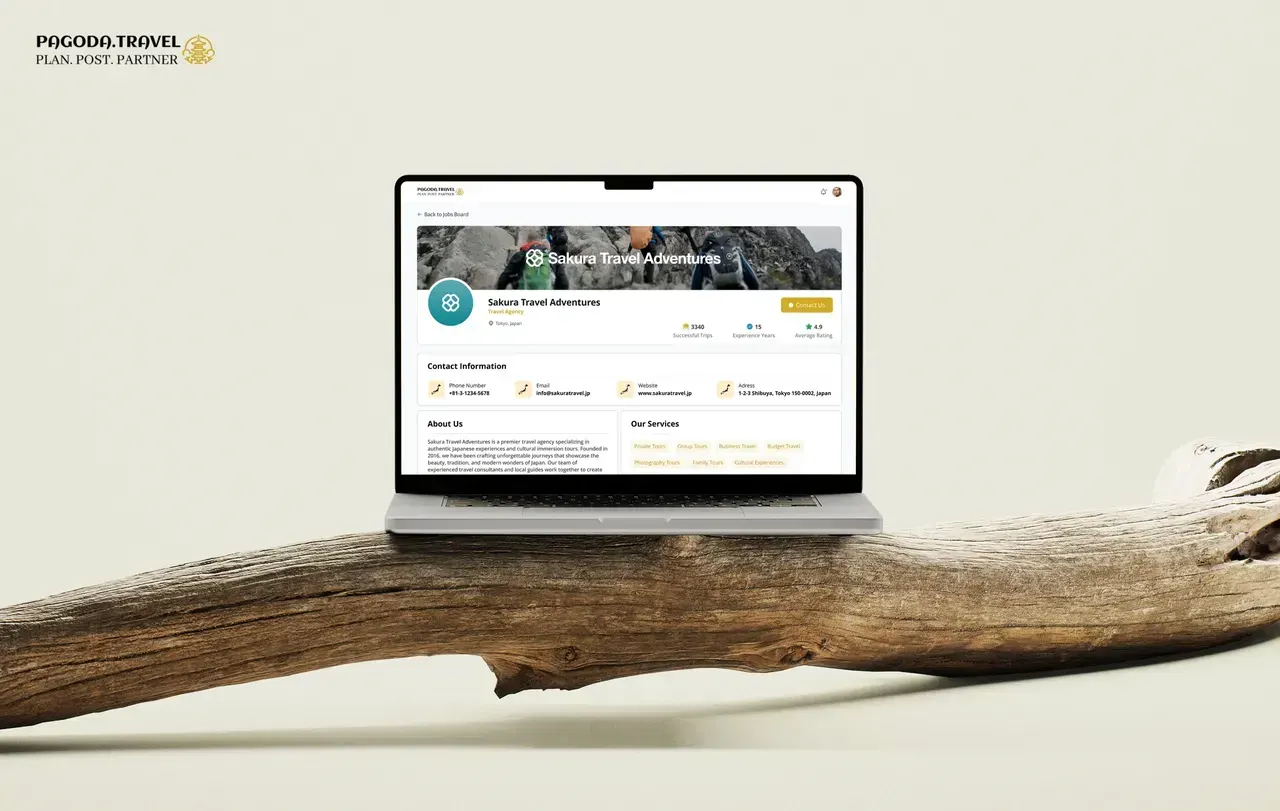
Pagoda's existing service model ran on multiple suppliers, fragmented email threads, spreadsheets, quotations and separate payment processes, the exact overhead a modern B2B marketplace is supposed to remove. The challenge wasn't designing individual screens, it was designing the connection between them: an itinerary needed to become a job with a single action, a job needed to surface the right guides based on destination and requirements, and a bid needed to become a hire, a payment and an ongoing conversation, all without either side of the marketplace, advisors or guides, ever feeling like they'd left one continuous flow.
Pagoda's existing service model ran on multiple suppliers, fragmented email threads, spreadsheets, quotations and separate payment processes, the exact overhead a modern B2B marketplace is supposed to remove. The challenge wasn't designing individual screens, it was designing the connection between them: an itinerary needed to become a job with a single action, a job needed to surface the right guides based on destination and requirements, and a bid needed to become a hire, a payment and an ongoing conversation, all without either side of the marketplace, advisors or guides, ever feeling like they'd left one continuous flow.
The Result
The Result
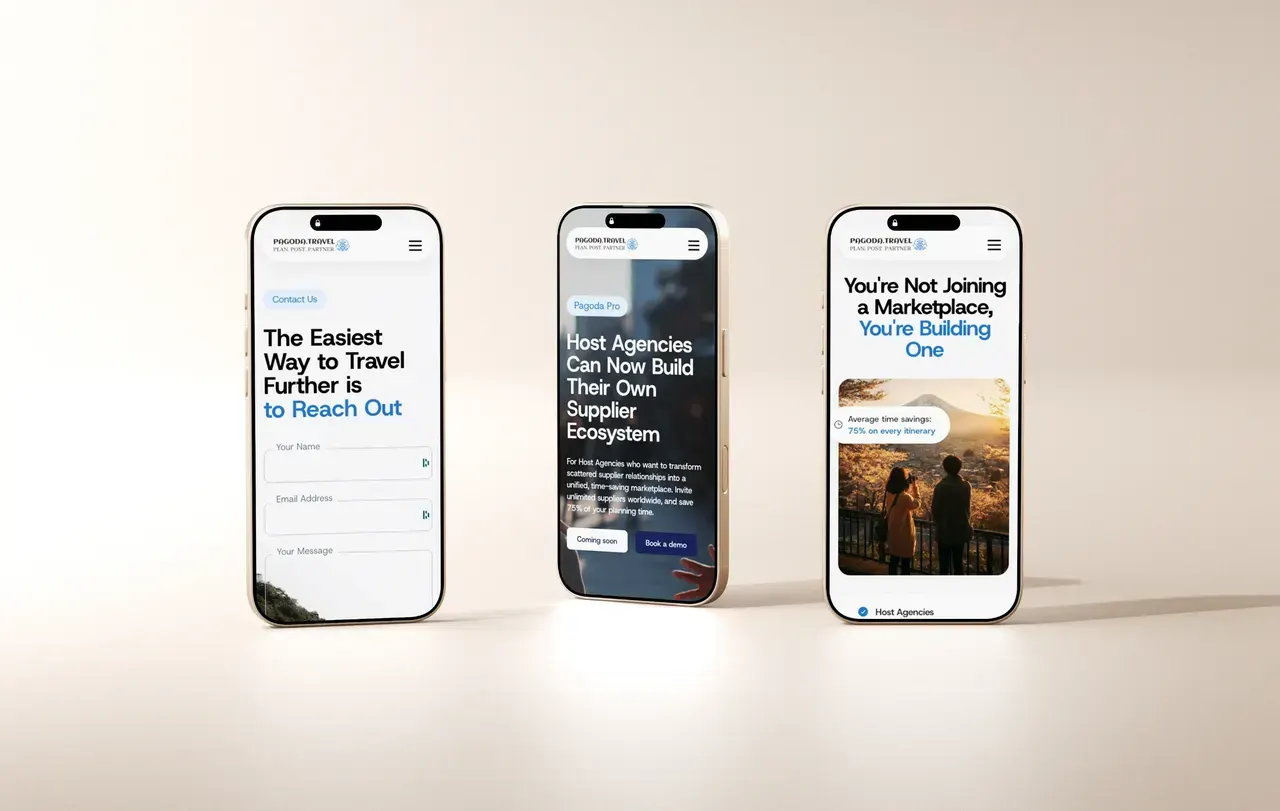
I designed the website to communicate Pagoda's proposition, programmes, pricing and trust model, directing advisors toward registration or a demo, and the web app to support account creation, itinerary building, job posting, guide applications, supplier comparison, collaboration, booking and payment as one shared workspace. Role-specific onboarding and entry points were built for advisors, guides and operators, and a consistent interface direction carried across the website and app so Pagoda could present one coherent, credible product built to expand beyond Japan.
I designed the website to communicate Pagoda's proposition, programmes, pricing and trust model, directing advisors toward registration or a demo, and the web app to support account creation, itinerary building, job posting, guide applications, supplier comparison, collaboration, booking and payment as one shared workspace. Role-specific onboarding and entry points were built for advisors, guides and operators, and a consistent interface direction carried across the website and app so Pagoda could present one coherent, credible product built to expand beyond Japan.
Success Framework
Success Framework
Pagoda's product was not formally tested after delivery, so what follows is a hypothesis-led success framework, not measured results. These are proposed targets pending validation through usability testing and a limited marketplace pilot, treated with the same rigour a tested case study would get, but clearly labelled as projections.
Pagoda's product was not formally tested after delivery, so what follows is a hypothesis-led success framework, not measured results. These are proposed targets pending validation through usability testing and a limited marketplace pilot, treated with the same rigour a tested case study would get, but clearly labelled as projections.
First-Week Activation
Hypothetical target: 45 to 55% of new advisors create an itinerary within their first week.
Core Task Success
Hypothetical target: 80 to 90% success across core itinerary-planning tasks in usability testing.
Itinerary Build Time
Hypothetical target: 25 to 35% reduction in time to build a complete itinerary.
Marketplace Responsiveness
Hypothetical target: 60 to 75% of published jobs receive a qualified bid within 24 hours.
Personal Reflection
Personal Reflection
Pagoda is the most complex system I've designed end to end. This wasn't a marketing site with a contact form bolted on, it was two connected layers of a live two-sided marketplace: distinct roles for advisors, guides and operators, real-time messaging built on Supabase, a drag-and-drop itinerary builder that could turn any single day of a trip into a biddable job, and an admin layer sitting on top of every conversation and transaction. The real challenge was never the visual layer, it was the product architecture underneath it, how an itinerary becomes a job, how a job surfaces the right guides, how a bid becomes a hire, a payment and an ongoing conversation, all without either side feeling like they'd left one continuous flow. Designing the in-conversation escalation path, a panic button that alerts admin in real time and stays visible to both parties, taught me as much about trust and conflict resolution as it did about interface design. Pagoda pushed me to stop thinking like someone designing screens and start thinking like someone designing a system, and it's also the project that taught me to be honest about what I can and can't claim: without a formal test after launch, the responsible thing is presenting targets as hypotheses, not results.
Pagoda is the most complex system I've designed end to end. This wasn't a marketing site with a contact form bolted on, it was two connected layers of a live two-sided marketplace: distinct roles for advisors, guides and operators, real-time messaging built on Supabase, a drag-and-drop itinerary builder that could turn any single day of a trip into a biddable job, and an admin layer sitting on top of every conversation and transaction. The real challenge was never the visual layer, it was the product architecture underneath it, how an itinerary becomes a job, how a job surfaces the right guides, how a bid becomes a hire, a payment and an ongoing conversation, all without either side feeling like they'd left one continuous flow. Designing the in-conversation escalation path, a panic button that alerts admin in real time and stays visible to both parties, taught me as much about trust and conflict resolution as it did about interface design. Pagoda pushed me to stop thinking like someone designing screens and start thinking like someone designing a system, and it's also the project that taught me to be honest about what I can and can't claim: without a formal test after launch, the responsible thing is presenting targets as hypotheses, not results.
Product Vision & Next Steps
Product Vision &
Next Steps
The logical next step is validation, usability testing the itinerary-building and bidding flows with real advisors and guides, followed by a limited marketplace pilot to see whether the hypothesised targets, activation, task success, response time, hold up against real behaviour. The platform itself was designed as a foundation built to expand beyond Japan, so once core workflows are validated, the same architecture, roles, itinerary-to-job pipeline, white-labelled proposals, is built to support new markets without a redesign.
The logical next step is validation, usability testing the itinerary-building and bidding flows with real advisors and guides, followed by a limited marketplace pilot to see whether the hypothesised targets, activation, task success, response time, hold up against real behaviour. The platform itself was designed as a foundation built to expand beyond Japan, so once core workflows are validated, the same architecture, roles, itinerary-to-job pipeline, white-labelled proposals, is built to support new markets without a redesign.